
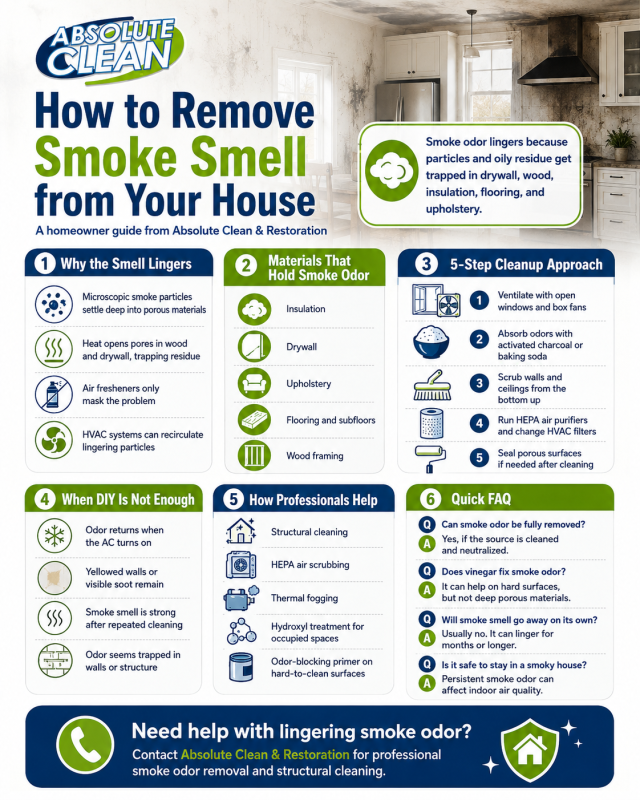
If your home still smells like smoke after cleaning, the odor is probably not just sitting on the surface. Smoke particles can settle into drywall, wood, flooring, insulation, upholstery, and even your HVAC system.
Candles, sprays, vinegar bowls, and air fresheners may help for a little while, but they usually do not remove the source. To get rid of smoke smell for good, you need to clean the residue, improve the air, and address any porous materials that absorbed the odor.
Why Smoke Smell Lingers
Smoke odor comes from tiny particles and oily residue. These particles are light enough to travel through a home and small enough to settle into cracks, wall cavities, fabrics, and vents.
Heat can also make the problem worse. During a fire or heavy smoke event, materials like wood and drywall can expand slightly. As they cool, smoke residue can become trapped inside porous surfaces. That is why the smell may return even after the room looks clean.
Common materials that hold smoke odor include:
- Drywall
- Wood framing
- Insulation
- Carpet and padding
- Upholstery
- Curtains and fabric
- Flooring and subfloors
- HVAC ducts and filters
The more porous the material, the harder it is to clean with basic household methods.
Start With Ventilation
The first step is to move contaminated air out of the home.
Open windows and use box fans to push smoky air outside. If possible, create cross-ventilation by opening windows on opposite sides of the house. This helps pull fresh air in while pushing stale air out.
Ventilation alone will not remove smoke odor from walls or fabrics, but it can reduce the amount of smoke particles still floating in the air.
Use Odor Absorbers
After ventilating, place odor absorbers in the affected rooms. Activated charcoal and baking soda can help absorb some lingering smells from the air.
They work best as a support step, not the full solution. If smoke residue is trapped inside drywall, upholstery, or insulation, odor absorbers will not be enough on their own.
Clean Walls, Ceilings, and Hard Surfaces
Smoke residue can settle on walls, ceilings, cabinets, trim, doors, and floors. These surfaces should be cleaned carefully with a product designed to break down oily residue.
When cleaning walls or ceilings, work from the bottom up. Starting at the top can cause dirty water to run down the wall and leave streaks.
Hard surfaces like glass, metal, and tile are easier to clean because smoke sits on the surface. Drywall, wood, and unfinished materials are more difficult because they can absorb the odor.
Replace HVAC Filters and Check the System
Your HVAC system can spread smoke particles through the home. If the smoke smell gets stronger when the heat or air conditioning turns on, the odor may be in the ductwork or filters.
Replace the furnace or air filters right away. If the odor continues, the system may need professional cleaning or air scrubbing.
When DIY Cleaning Is Not Enough
Some smoke odors are too deep for household cleaning. If the smell keeps coming back, the residue may be trapped in walls, flooring, insulation, or structural materials.
Signs you may need professional smoke odor removal include:
- The smell returns after cleaning
- The odor gets worse when the HVAC system runs
- Walls or ceilings are yellowed
- Soot remains on surfaces
- Smoke odor is strong in closets, cabinets, or wall cavities
- Upholstery or carpet still smells after cleaning
At that point, the issue is not just air freshening. It is structural odor removal.
How Professionals Remove Smoke Odor
Professional smoke odor removal focuses on reaching the source of the smell.
The process may include:
-
Inspection
The affected rooms, surfaces, contents, and HVAC system are checked for smoke residue. -
Structural cleaning
Walls, ceilings, floors, trim, cabinets, and other surfaces are cleaned to remove soot and oily residue. -
HEPA air scrubbing
HEPA filtration helps remove fine particles from the air. -
Odor neutralization
Equipment such as thermal foggers or hydroxyl generators may be used to neutralize odor molecules in areas that basic cleaning cannot reach. -
Sealing when needed
If a surface cannot be fully cleaned, an odor-blocking primer may be used after cleaning to seal in remaining residue.
The goal is to remove and neutralize the smoke particles instead of covering them with fragrance.
Be Careful With Ozone Machines
Ozone machines should not be used casually. If used incorrectly, ozone can irritate lungs, damage rubber, affect electronics, and harm plants or pets.
For occupied homes, professionals may use safer alternatives such as hydroxyl treatment, depending on the situation. If you are considering ozone, talk with a restoration professional first.
Get Help With Smoke Odor Removal
Smoke smell can linger for months if the source is not properly treated. The sooner the residue is cleaned and the air is filtered, the better chance you have of preventing the odor from settling deeper into the home.
Absolute Clean & Restoration helps homeowners with smoke odor removal, structural cleaning, upholstery cleaning, air quality restoration, and fire damage cleanup in Belleville and the surrounding Metro East area.
If your home still smells like smoke after cleaning, contact Absolute Clean & Restoration for a professional odor assessment.
Frequently Asked Questions
Can smoke smell be completely removed from a house?
Yes, in many cases smoke odor can be removed when the source is properly cleaned and treated. The key is removing smoke residue from surfaces, fabrics, air systems, and porous materials instead of masking the smell.
Does vinegar remove smoke smell?
Vinegar may help reduce light smoke odor on some hard surfaces, but it will not remove smoke trapped inside drywall, insulation, upholstery, carpet padding, or wall cavities.
How long does smoke smell last in a house?
Smoke odor can last for months or longer if the residue is not removed. Heat, humidity, and air movement can cause trapped smoke particles to release odor again over time.
Is it safe to stay in a house that smells like smoke?
A strong or persistent smoke smell may indicate soot, ash, or fine particles are still present. These particles can irritate breathing, allergies, or asthma. If the smell is heavy or does not improve, a professional assessment is a good idea.
Can smoke odor get into the HVAC system?
Yes. Smoke particles can enter filters, ducts, and vents. If the smell gets stronger when the HVAC system runs, the system may be circulating smoke residue through the house.
Does insurance cover smoke odor removal?
It may, depending on the cause of the smoke damage and the details of your policy. Smoke cleanup from a covered fire or sudden accidental event is often part of a restoration claim, but you should confirm coverage with your insurance provider.
Article by
Scott Ross